


Don't let uncertainty stop the planning
By Linda Hughes
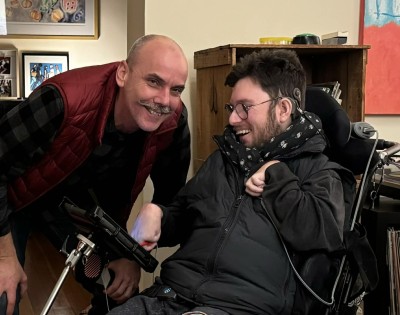
Image: Jac (right) with housemate Gavin
One of the great hopes that came with the NDIS was that people with disability and their families could feel more secure about the future. That they could plan, knowing there would be ongoing support for their family member with disability.
I think it is fair to say that sense of security has never been completely realised. And right now, uncertainty feels particularly acute.
The NDIS legislation changed significantly in August 2026, with changes affecting areas including access, planning, the use of funding and how some supports may be funded. Some changes are already in effect, while others are being introduced over time. [ndis.gov.au].
Add Australia's housing pressures to the mix, and it is understandable that families might be asking:
Will there be enough funding now or in a few years? Will my family member be able to afford a home? Should we wait until things become clearer?
And what do we tend to do when things feel uncertain?
We hunker down. We hold on to what we have. We wait for the dust to settle before making big decisions.
So we might put the idea of our family member leaving home in the too hard basket for now.
Some things haven't changed
The first is that people with disability have a right to choose where, how and with whom they live.
Australia's obligations under Article 19 of the UN Convention on the Rights of Persons with Disabilities recognise the equal right of people with disability to live in the community. Article 19 specifically says people must have the opportunity to choose their place of residence and who they live with, and must not be obliged to live in a particular living arrangement. [un.org]
That principle is bigger than the NDIS.
The second thing worth remembering is that individualised living did not begin with the NDIS.
Long before the NDIS, people with disability and families were finding creative ways for people to live well in ordinary homes and neighbourhoods: living alone, with housemates, with hosts and in other arrangements designed around one person. Often these individualised living arrangements were developed with a little individualised funding, lots of creativity and good will.
Individualised funding has been important to creating these individualised living arrangements because it gives people greater opportunity to truly design support around the individual rather than fitting the individual into an existing service model.
But funding is only one ingredient.
A home and support are ingredients, not the whole recipe
When we start thinking about individualised living, it is very easy to focus on two big questions:
Where will the person live?
and
How much funding for support?
Of course these are important. But I sometimes think of them as the flour and eggs in a cake. Essential ingredients, but flour and eggs alone don't make a cake.
There are other ingredients that are necessary for a person with disability to thrive living in their own home.
The research on successful individualised living arrangements shows us what else is necessary – the other ingredients - for people with disability to thrive in their own home
There needs to be vision and leadership. The person, family and supporters need as clear idea of what they are trying to create, and people around the person who will champion that vision.
There needs to be choice and control. This remains important even when someone has significant disability, communicates differently or requires substantial support with decision-making. The people around the person need to listen closely, understand the person's will and preferences, and support the person to have real influence over everyday life.
There needs to be planning one person at a time. Instead of starting with a vacancy, a house or a group of people who can be put together, start with the person.
And planning cannot be something we do once and put in a drawer. It continues as the person's circumstances, relationships, aspirations and life change.
And there needs to be connection and belonging. A home is not an island. It's part of a neighbourhood and a community. It provides opportunities for friendship, contribution, relationships and valued social roles, and for a person to be known as an individual. Our relationships and connections make our life rich and interesting and also serve as an important safeguard.
So when should families start?
This is where it gets difficult.
Research led by Flinders University's Caring Futures Institute has been examining how people with intellectual disability and their families plan transitions from the family home.
The researchers point to a familiar problem: many families do not have future plans in place and the person may remain at home until a crisis occurs, such as a parent becoming ill or dying, forcing everyone to act. Importantly, the researchers also stress that there is no one-size-fits-all approach to where and how people want to live. [blogs.flin...ers.edu.au]
That creates something of a catch-22.
It never feels like quite the right time to start.
But if we wait until there is a crisis, our choices can become much narrower.
And this leaves the person with disability vulnerable to the least-worst option rather than the best options that are developed with thoughtfully planning for the person's good life.
So what can we do now?
We don't need to know exactly what the NDIS will look like in five years to begin.
We don't need to have a house.
We don't need to know the final support model.
We don't even need to know exactly who the person might live with.
We can start with the things that are possible now.
We can build a vision.
We can get to know what home means to the person.
We can explore different ways people live.
We can strengthen decision-making support.
We can build relationships and community connections.
We can think about who will champion and safeguard the person's vision into the future.
We can help the person develop skills, roles, routines and connections that will travel with them wherever they eventually live.
We can meet other families and people with disability who have already travelled this road.
And we can start planning, experimenting and learning.
Because perhaps the biggest risk in a period of uncertainty is allowing uncertainty to make the decisions for us.
We might not be able to control what happens around the NDIS. But we can keep building the foundations for a good life.
And we can start now.
If you would like to know more about individualised living arrangements, hear from people with disability and families or want to know what you can do now, join us for the 3-part "My Home My Way" online workshop coming up in November. Click on the link below for dates, details and to register: